On paper, packing a kilogram of protein into a stand-up pouch looks elementary: pour the powder, close the zipper, and send the package to the box. In practice, production owners know the flip side of the process: over-weighing expensive raw materials, clouds of fine dust, contaminated seals, and defects that are sometimes discovered only at the distributor's end. If a company plans to increase production volumes and avoid losing money at every stage of packaging, the solutions offered by ZOMUKIKAI whey protein filling solution can serve as the basis for creating a full-fledged automated line. Simply putting a dispenser and a sealer next to each other is not enough—all mechanisms must work in sync, without delays and constant readjustments. Let's look at how such equipment is structured and which technical details truly deserve attention upon purchase.
Ten Years of ZOMUKIKAI Packaging Engineering Expertise
ZOMUKIKAI has been developing packaging equipment for the food and sports industries for over 10 years. One of its main areas of focus is complete lines for filling whey protein into ready-made stand-up zipper pouches. The most common format is a one-kilogram package. At first glance, nothing out of the ordinary. But this is precisely where the subtleties begin, which do not mix well with the principle of "let's install a standard machine and figure it out as we go."
A kilogram of powder creates significant pressure on the pouch, and its contents during dosing are far from always behaving predictably. At the same time, it is necessary to open the zipper, accurately measure the product, keep the neck clean, and securely seal the package. Missing even a single step can ruin the result of all previous work.
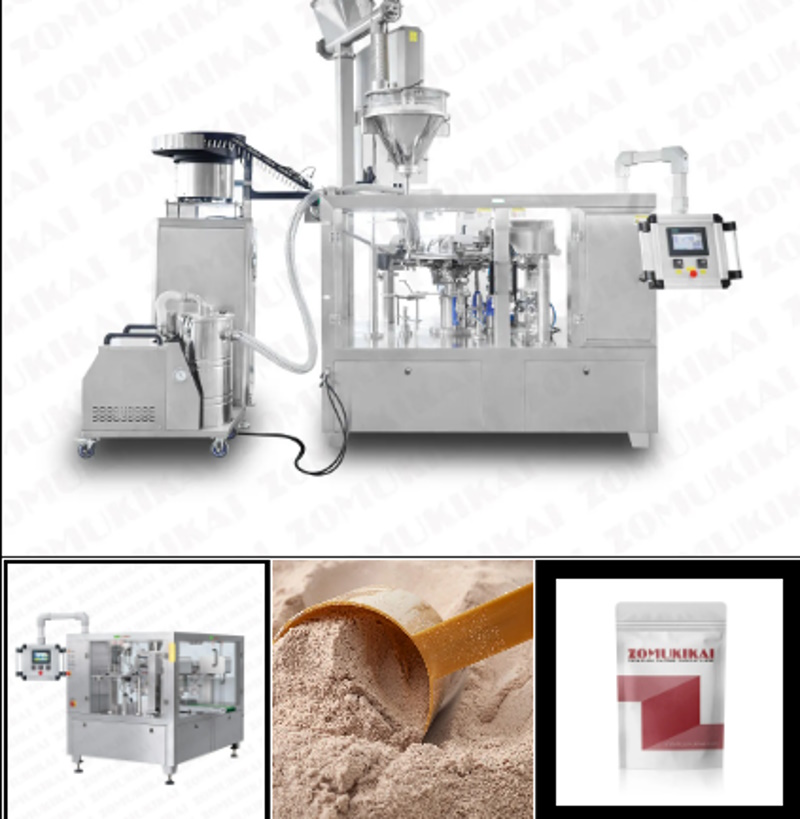
The integrated line includes:
- ready-made pouch feeding and opening unit;
- servo auger filler;
- vacuum dust extraction system;
- automatic measuring scoop insertion mechanism;
- double heat sealing unit.
The advantage of this architecture lies in the synchronized operation of the equipment. There is no need to manually transfer packages between separate machines and adjust each subsequent stage to the previous one.
Specifics of Stand-Up Pouches and Raw Materials
For one-kilogram protein, stand-up pouches with a bottom gusset and a resealable zipper are used. It is convenient for the consumer: the package stands on the shelf, opens without scissors, and can be reclosed after use. The manufacturer, however, has to take the other side of the design into account. The pouch must be securely held by the grippers, opened without skewing, and maintain its shape under the weight of the powder.
The raw material adds complexity as well. WPC (concentrate), WPI (isolate), and WPH (hydrolysate) differ not only in composition. Their physical properties can noticeably affect feed speed and dosing stability. One powder flows easily through the auger, another sticks to the walls, and a third literally hangs in the air during loading. Ultra-fine and fatty mixtures are especially finicky.
When selecting equipment, engineers take into account:
- Flowability. If the powder moves poorly, the feed becomes uneven, leading to dosage fluctuations.
- Fat content. Raw materials can stick to working surfaces. Special non-stick executions are provided for such cases.
- Dispersity. The finer the particles, the more attention must be paid to dust extraction.
- Caking. Product that has compacted in the hopper can disrupt the normal filling of the auger.
There is no universal setting for all types of protein here. Changing the formula may require different feeding and dosing parameters. Therefore, it is advisable to test the equipment on several samples of raw materials rather than just on the most convenient powder from a laboratory jar.
Servo Auger Precision and Raw Material Savings
With expensive isolate and hydrolysate, every extra gram turns into direct expenses. Suppose the over-weight is small on a single package. But when there are thousands of such packs, the overconsumption ceases to be a trifle. This is why rather strict requirements are imposed on the dosing unit.
A servo auger filler is responsible for the dosing accuracy in the line. The servo drive controls the rotation of the auger, regulating the powder feed and ensuring portion repeatability. For a one-kilogram package, the declared accuracy is ±0.5% per pack.
What this design brings to production:
- Rotation control. The auger speed is adjustable, making it possible to control product delivery more precisely.
- Portion stability. With properly selected settings, the mass of the packages deviates less from the target value.
- Raw material savings. The likelihood of constant over-weighing is reduced, which is especially critical when working with expensive blends.
- Product customization. The dosing mode can be adapted to the specific characteristics of a particular powder.
However, the servo drive by itself does not guarantee ideal accuracy under all circumstances. If the raw material cakes, changes density, or enters the auger unevenly, the result may also change. Therefore, during testing, it is important to check not only the average portion mass, but also the spread of values between individual packages.
Servo System for Opening Deep Zipper Locks
Opening a standard pouch is usually less troublesome. But a deep zipper requires a special mechanism. In the considered design, the distance from the top edge of the package to the zipper is 40–45 mm. For the grippers, this is a significant feature: they must reach the required zone, push the edges apart, and not damage the material.
The line uses a servo-driven zipper opening system. It ensures controlled mechanism movement and helps prepare the pouch for filling.
When selecting this unit, the following are taken into account:
- zipper location depth — 40–45 mm;
- width and geometry of the stand-up pouch;
- stiffness of the packaging film;
- positioning accuracy of the grippers.
For certain tasks, a pneumatic option is also provided. Its use depends on the package characteristics and production requirements. The point is not to install the most complex mechanics possible, but to ensure it consistently opens the specific packaging. Otherwise, the operator will have to constantly adjust the pouches manually, making automation quite conditional.
Three-Stage Dust Control Before Sealing
Protein dust is not just a matter of workshop cleanliness. It can ruin the most critical section of packaging. It is enough for fine particles to get between the film layers in the sealing zone for the joint quality to deteriorate. Externally, the package may look quite decent, but during transportation through a contaminated area, air will start to penetrate or the product will spill out.
The ZOMUKIKAI line provides three levels of control:
- Special hopper. The design of the loading unit takes into account the features of powdery raw materials and helps organize their feed.
- Vacuum dust collector. Captures particles generated during the movement and dosing of protein.
- Neck cleaning. Before heat sealing, powder residue is removed from the seam formation area.
The final stage is especially important. You can dose the product as accurately as you like, but if its particles remain on the surface of the future joint, tightness will be compromised. And checking every single package in the warehouse is a dubious pleasure.
There is also a less obvious result. Clean packages look neater, less powder settles on them, meaning the finished product retains its marketable appearance. For sports nutrition, which is often sold through marketplaces, this is far from a minor detail.
Automatic Scoop Insertion into the Pouch
A measuring scoop is a small plastic accessory whose absence the buyer notices instantly. Manually inserting it into each package in large-scale production? Of course, you can. But then part of the advantages of the automated line is lost: an extra operation appears, staff workload increases, and quality control becomes more complex.
To solve the "one measuring scoop per pouch" task, a Teflon-coated vibratory bowl is used. It guides the accessories to the feeding unit. Teflon reduces the sticking of plastic scoops to the surface, which helps prevent jams during movement.
The system involves:
- Vibratory bowl. Ensures orientation and feeding of the scoops.
- Teflon coating. Reduces friction and the likelihood of accessories sticking.
- Photoelectric sensor. Monitors the passage of the scoop and detects feeding irregularities.
The principle is simple: exactly one measuring scoop must end up in each package. The sensor helps monitor this operation, saving personnel from manual batch-wide assembly. A small detail? For the buyer, it is part of the kit; for the enterprise, it is yet another operation removed from the staff.
Double Heat Sealing for a Durable Seam
A zipper is convenient for reuse, but by itself does not replace primary sealing. Therefore, after filling the pouch and inserting the scoop, the package goes to heat sealing. For a one-kilogram volume, connection strength is especially important: the contents create loads on the walls and the top of the package during handling and transportation.
The line uses a double heat sealing system. It forms two welded joints, increasing closure strength and ensuring a neat appearance of the finished packaging.
Seam quality is affected by:
- temperature of the heating elements;
- heating duration;
- pressure when bonding the film layers;
- width and uniformity of the weld zone.
Overheating here is just as undesirable as insufficient temperature. In the first case, you can damage the packaging material; in the second, you get a weak joint. Therefore, settings are selected taking into account the film type and tested on real samples. A nice-looking seam in a photo does not guarantee it will survive the journey to the distributor's warehouse.
Architecture of the Ideal Protein Filling Line
When choosing equipment for filling WPC, WPI, and WPH, it is worth evaluating the entire technological chain rather than individual machines based on a list of specs. The ZOMUKIKAI line combines servo auger dosing with ±0.5% accuracy, vacuum dust extraction, deep zipper opening, automatic measuring scoop installation, and double heat sealing for 1 kg stand-up pouches. The company's decade-plus packaging engineering experience is complemented by preliminary testing on the customer's powder and packaging material samples. Such tests make it possible to verify the mechanisms' operation before shipping the equipment and reduce the risk of unpleasant surprises during production launch.